
SEO Content Strategy for a New Website: A Practical Guide
When we start a new website, one of our main goals is to attract the right traffic. Why do I say the right traffic? Because every website has a purpose. Some businesses want to generate more leads, while others want to get more customers, increase sales, or build brand awareness.
Simply getting more visitors does not necessarily help achieve these goals. What matters is attracting people who are actually interested in what your business offers.
Building an effective SEO content strategy for a new website starts with understanding your audience and creating the right foundation. Before publishing content, there are a few important things you need to get right.
In this article, we will look at the important steps involved in building an SEO content strategy for a new website, from audience research and website structure to keyword research, link building, and content optimization.
Key Takeaways
- Understand your target audience before planning website content.
- Build a clear website structure from the beginning to avoid unnecessary changes later.
- Focus on user experience because good content alone is not enough to keep visitors engaged.
- Research your audience’s needs and choose relevant keywords with realistic competition.
- Use internal linking and topical clusters to organize related content.
- Build website authority through relevant, quality backlinks rather than spammy link-building practices.
- Regularly monitor content performance and update articles based on opportunities for improvement.
1. Understand Your Target Audience
The first thing you need to do when creating a website is understand your target audience.
Before deciding what content to publish, you need to know who you are trying to reach. Understanding your audience will help you identify what information they are looking for, what problems they are facing, and what type of content will be useful to them.
For example, imagine you are running a digital marketing agency.
Your target audience might include small-business owners who want to generate more leads through organic search. They may be looking for information about SEO, content marketing, lead generation, and customer acquisition.
Once you understand this audience, it becomes easier to decide which topics your website should cover and which topics are not relevant to your business.
Audience research also helps you understand the language your potential customers use when searching online. This is important because your content should address the actual questions and problems of your audience rather than simply focusing on topics you want to write about.
The better you understand your audience, the easier it becomes to create relevant content that attracts the right visitors.
2. Fix Your Website Structure Before Publishing Content
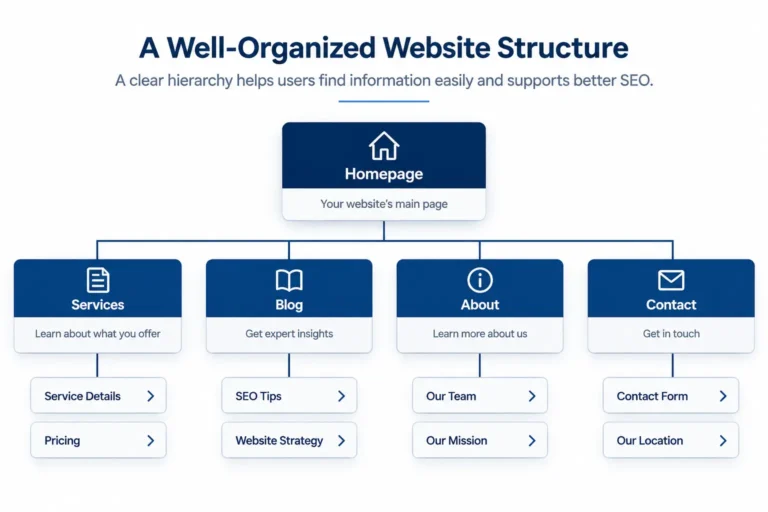
After understanding your audience, the next important thing is to plan your website structure.
Why is this important?
When starting a new website, you may have only a few pages and articles. This makes it easier to organize everything properly. If you establish a good structure at the beginning, you can avoid unnecessary complications in the future.
For example, imagine you start publishing blog articles without giving much importance to categories and URL structure.
Initially, everything may look fine. But after publishing 50 or 100 articles, you realize that your website categories are not properly organized or that your existing URL structure is not suitable.
Now you want to change your blog categories and URLs.
This can create additional work because some of your existing pages may already be indexed in search engines, receiving organic traffic, or earning backlinks.
Changing URLs without proper planning can lead to broken links and lost search visibility. You may need to implement 301 redirects from the old URLs to the new ones, update internal links, and check whether search engines can access the new pages correctly.
That is why planning your website structure from the beginning is important.
What Should You Plan?
Before publishing content, think about:
- Main website pages: Identify the important pages your website needs, such as Home, About, Services, and Contact.
- Content categories: Organize your blog into relevant categories based on your main topics.
- URL structure: Choose a simple and consistent URL format that can accommodate future content.
- Internal navigation: Make it easy for visitors to move between related pages.
- Content relationships: Think about how different articles will connect with each other.
You do not need a complicated website structure. A simple, logical structure that can grow with your website is usually a better starting point.
3. Focus on User Experience
Another important thing to consider is user experience.
You may write a very informative and useful article, but what happens when someone visits your website and finds it difficult to read or navigate?
They may leave without reading the content or exploring other pages.
Good content is important, but the experience visitors have while accessing that content also matters.
For example, imagine someone visits your blog to read an article. The page takes too long to load, the text is difficult to read on mobile, and there are too many distracting elements.
Even if the article provides useful information, the poor experience can discourage that visitor from continuing.
To avoid this, focus on a few important things:
- Page speed: Make sure your website loads reasonably quickly.
- Mobile responsiveness: Your website should work properly on different screen sizes.
- Readability: Use clear fonts, suitable font sizes, headings, and enough spacing.
- Navigation: Visitors should be able to find important pages and related articles easily.
- Clean design: Avoid unnecessary pop-ups, distracting elements, and excessive advertisements.
User experience is also important for business outcomes. A visitor who can easily understand your content and navigate your website has a better opportunity to become a lead or customer.
Before moving into content creation, make sure these three foundations are in place:
- Understand your target audience.
- Plan your website structure.
- Focus on user experience.
4. Research What Your Audience Is Searching For
Once you have completed audience research and planned your website structure, you can move to the content planning stage.
Now you have a better understanding of who your target audience is. The next step is to research what they want to know and what they are searching for online.
There are different ways to understand this.
You can start by identifying the common questions, problems, and challenges your potential customers face.
You can also use tools such as AnswerThePublic and Google Trends to explore search questions, related topics, and changes in interest over time.
For example, if your website focuses on business growth and marketing, your audience might be searching for questions such as:
- How to generate more leads for a small business?
- How to improve customer retention?
- What is a marketing funnel?
- How to create an SEO content strategy?
- How to get more organic traffic?
These questions can help you identify potential article topics.
However, remember that not every topic you discover needs to become an article. You should select topics based on their relevance to your audience and business goals.
5. Do Keyword Research Before Creating Content

Keyword research is one of the most important parts of an SEO content strategy because it helps you understand what people are searching for and how competitive different search terms may be.
Keyword research tools can provide information such as estimated search volume, keyword competition, and related search terms.
This information helps you make better decisions about which keywords to target.
For a new website, one important thing to remember is that you should not focus only on high-volume, highly competitive keywords.
A new website usually has less established authority and fewer backlinks than older, established websites. Competing immediately for highly competitive keywords can therefore be difficult.
Instead, start by identifying relevant keywords with more manageable competition.
For example, rather than immediately targeting a broad keyword such as “digital marketing,” you could explore more specific topics such as:
- Digital marketing strategies for small businesses
- How to generate leads through content marketing
- Customer retention strategies for startups
These more specific search terms may have a clearer search intent and can be more realistic starting points, depending on the actual competition.
As your website publishes useful content, earns relevant backlinks, and builds a stronger presence in search results, you can gradually target more competitive topics.
Don't Choose Keywords Based Only on Search Volume and Competition
There is one more important thing to remember when choosing keywords: relevance.
Do not select a keyword simply because it has high search volume or low competition.
The keyword must be relevant to your website, your audience, and your business goals.
For example, imagine your business provides SEO services, but you create content targeting a keyword about free graphic design tools simply because it has good search volume and relatively low competition.
Even if that article ranks and attracts visitors, those visitors may have no interest in your SEO services.
As a result, the traffic may not contribute much to your actual business goals.
This is why keyword selection should consider three important factors:
- Relevance: Is the keyword related to your business and target audience?
- Search intent: Does the content you plan to create match what the searcher wants?
- Competition and demand: Is there a realistic opportunity to rank for the keyword, considering its search demand and competition?
The goal is not simply to rank for more keywords. It is to attract people who are genuinely interested in what your website offers.
6. Build Internal Links Between Related Articles
After publishing content, the next thing you need to focus on is internal linking.
Internal linking means linking one page of your website to another relevant page on the same website.
For example, imagine you have published an article about SEO content strategy. In that article, you explain keyword research and mention that it is an important part of content planning.
If you also have a separate article explaining keyword research in detail, you can link to that article from your SEO content strategy article.
This helps visitors discover more relevant information without having to search for it themselves.
Internal linking also helps search engines discover your website pages and understand how different pieces of content are related.
Why Is Internal Linking Important?
- Improves navigation: Readers can easily move between related articles.
- Helps content discovery: Search engines can discover other pages through internal links.
- Provides context: Links help establish relationships between related topics.
- Distributes link equity: Internal links can help distribute the value of external links across relevant pages.
When adding internal links, focus on relevance. Link to pages that provide additional information and genuinely help the reader.
Avoid adding links simply to increase the number of internal links on a page.
7. Use Topical Clusters to Organize Your Content
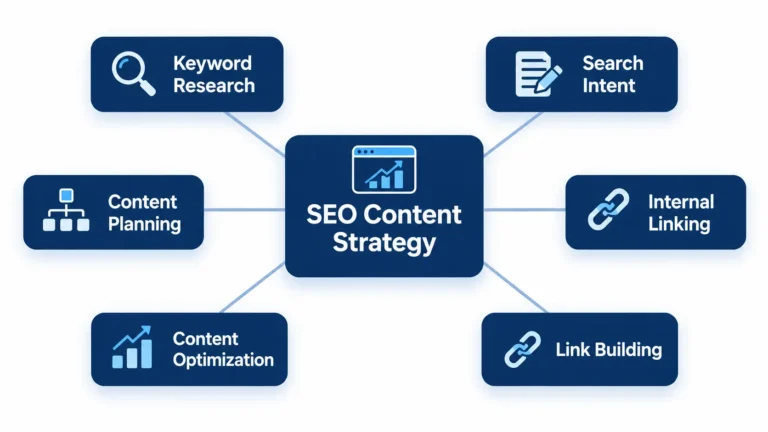
Topical clustering is another important part of an SEO content strategy.
A topical cluster is a group of related articles organized around a broader subject. Usually, it includes one main article covering the broader topic and several supporting articles that explain specific subtopics in more detail.
These articles are connected through relevant internal links.
For example, if your website focuses on digital marketing, you could create a content cluster around content marketing.
Your main article might be:
Content Marketing: A Complete Guide
Supporting articles could include:
- How to Create a Content Marketing Strategy
- Content Marketing for Small Businesses
- How to Create a Content Calendar
- Content Distribution Strategies
- How to Measure Content Marketing Performance
Each supporting article covers a specific part of the broader topic and links to other relevant articles in the cluster.
This approach helps you organize your content and cover a subject from different angles rather than publishing unrelated articles.
It also gives readers a way to explore a topic in more detail.
For a new website, topical clusters can be a useful way to plan content because they help you build a focused library of relevant information over time.
8. Build Website Authority Through Quality Backlinks
Another important part of SEO is building authority through backlinks.
A backlink is a link from another website pointing to your website.
Backlinks can help search engines discover your content and understand its reputation and relevance. Links from relevant, trustworthy websites can contribute to your website’s authority.
For a new website, building backlinks can take time. However, it is important to focus on quality rather than simply trying to increase the number of backlinks.
One common mistake new website owners make is buying backlinks from irrelevant or spammy websites because they want to improve rankings quickly.
These links may sometimes create the appearance of short-term progress, but manipulative link-building practices can put your website at risk of search engine penalties or ranking losses.
Instead, focus on earning relevant backlinks through useful content and genuine relationships.
Some approaches include:
- Publishing original, useful, and informative content that other websites may want to reference.
- Contributing valuable articles to relevant industry publications.
- Building relationships with businesses, publishers, and professionals in your industry.
- Creating useful resources and insights that naturally attract references.
- Participating in relevant industry discussions and communities where appropriate.
Remember, building quality backlinks is a long-term process. Focus on relevance, editorial value, and genuine recommendations rather than buying large numbers of links.
9. Monitor Content Performance and Update Your Articles
One thing you need to do regularly after publishing content is monitor its performance and make improvements when necessary.
Publishing an article does not mean your work is finished.
You need to check which articles are performing well, which are receiving impressions but not enough clicks, and which are struggling to gain visibility.
Tools such as Google Search Console and Google Analytics can help you understand different aspects of your website’s performance.
For example, Google Search Console can show you:
Which search queries are bringing impressions and clicks.
Which pages are receiving organic search traffic.
Your average search position for different queries.
Changes in impressions and clicks over time.
Based on this information, you can identify opportunities to improve your content.
How to Identify Content Improvement Opportunities
1. Identify articles ranking on page two or three.
If an article is appearing on the second or third page of search results, examine what might be missing.
Compare your article with the pages ranking above it. Are they providing more useful explanations? Are they covering additional questions? Is their content more closely aligned with the search intent?
Use these observations to identify gaps in your own article.
2. Improve articles ranking near the bottom of page one.
If your article is already ranking on the first page but appears near the bottom, look at the pages ranking above it.
Identify differences in content quality, relevance, depth, structure, and search intent.
You may find opportunities to improve your introduction, add missing explanations, clarify examples, or make the article easier to navigate.
3. Update outdated information.
Some articles contain information that becomes outdated over time.
Review your content regularly and update information, examples, links, and explanations when necessary.
4. Improve content based on actual search queries.
Sometimes an article starts receiving impressions for search queries that you did not originally target.
These queries can reveal additional questions your audience wants answered.
If the queries are relevant, consider improving the existing article to address them more clearly.
The important thing is to make updates based on actual opportunities rather than changing content randomly.
You should also avoid assuming that every article ranking on page two needs more words. Sometimes the real problem is search intent, content relevance, or competition rather than article length.
What's Next? Start Building Your SEO Content Strategy
If you are starting a new website, do not rush into publishing as many articles as possible.
Start with audience research, establish a clear website structure, and make sure visitors have a good experience.
Then move into content research and keyword selection. Focus on relevant topics that match your audience’s needs and your business goals.
As you publish content, connect related articles through internal links, organize them into topical clusters, and work on earning quality backlinks.
Finally, monitor your performance and improve your content based on what you learn.
SEO is an ongoing process. Your strategy should develop as your website grows, your audience’s needs become clearer, and you gather more information about what works.
Conclusion
An effective SEO content strategy for a new website is not just about finding keywords and publishing articles. It is about understanding your audience, building the right foundation, creating relevant content, and continuously improving it.
Start with the basics and focus on attracting the right audience rather than simply increasing website traffic.
When you build your website and content strategy with a clear plan from the beginning, you give your business a better foundation for long-term organic growth.