
How to Create a Lead Magnet That Converts: A Practical Guide
Most businesses know they need leads, and many create a free guide or a discount code to get them. But a lot of these offers get very few sign-ups, because they were made without much thought about who they are for. This article walks through how to create a lead magnet that converts, step by step, so the effort you put into it actually brings in potential customers.
Key Takeaways
- A lead magnet is something valuable offered in exchange for a person’s contact details.
- It matters because it gives your business a way to reach potential customers directly.
- Understanding your audience’s problem is the most important step.
- The format (ebook, template, discount code, free trial and so on) should match the problem and the person.
- Creating the lead magnet is not the end. You have to promote it where your audience spends time.
- Look at the results regularly and update the lead magnet based on what you learn.
What Is a Lead Magnet?
A lead magnet is something valuable that a business gives to a potential customer in exchange for their contact details, usually an email address. In most cases it is free. Common examples are guides, templates, checklists, discount codes, and free trials.
The word “valuable” is the important part. The person is paying with their contact details, so the offer has to feel worth it.
Why Is a Lead Magnet Important?
A lead magnet is important because it helps your business get the contact details of a potential customer. Without it, most visitors read your page, leave, and you never hear from them again.
Once someone signs up, you have a way to continue the conversation. You can share more useful content, build trust over time, and eventually tell them about your product or service. This is why lead magnets sit at the start of many marketing funnels and lead generation strategies.
How to Create a Lead Magnet That Converts
There are four main steps: understand your audience, provide real value, pick the right type, and then promote and improve it.
Step 1: Understand Your Audience
This is the most important step, because everything else depends on it. Before you create anything, get clear on three things:
- Who you want to attract.
- What they want.
- What problem they are facing right now.
If you skip this and create something based only on your own idea of what is useful, the lead magnet may look good but nobody will want it.
A few simple ways to learn this: read the questions customers ask you repeatedly, look at what they complain about in reviews or comments, and talk to a few people who are already in your target market. The goal is to describe their problem in their own words.
Step 2: Provide Real Value
A good lead magnet solves one specific problem. It should give the reader something they can understand or use quickly, without needing to buy anything first.
A common mistake is to try to cover everything. A small, focused offer usually works better than a large, general one. For example, “How to write a cold email” is easier to want than “Everything about sales.”
Quality also matters because your lead magnet is often the first thing a person experiences from your business. If it is weak, they will assume your paid product is weak too.
Step 3: Pick the Right Type of Lead Magnet
There are many types of lead magnets, so choosing the right one matters. The best type depends on the problem your audience has and how much effort they are willing to spend.
- Ebook or guide: Best for explaining a topic in depth. For example, a beginner’s guide to organic SEO.
- Template: Best for helping people finish a task faster. For example, a content calendar layout.
- Checklist: Best for making a process easy to follow. For example, a website launch checklist.
- Discount code: Best for turning interested buyers into customers. For example, 10% off a first order.
- Free trial: Best for software or subscription products, where people want to try the product before paying. For example, 14 days of free access to a tool.
- Free consultation or audit: Best for service businesses that sell expertise. For example, a short review of a website.
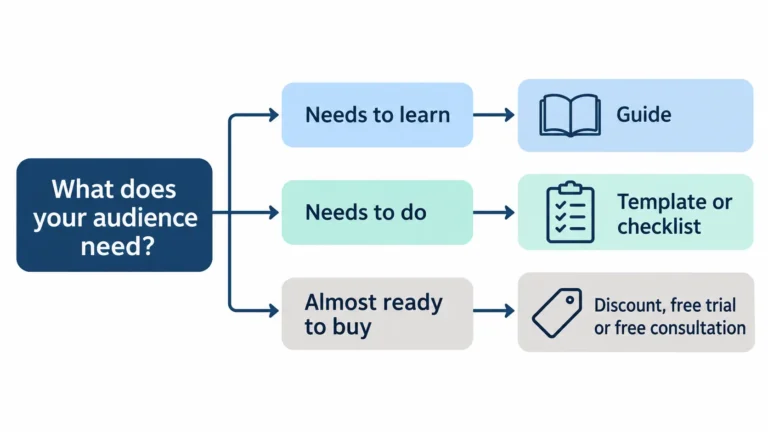
A simple way to decide: if your audience needs to learn something, a guide may work. If they need to do something, a template or checklist is often better. If they are almost ready to buy, a discount, free trial, or free consultation may convert better than educational content.
Step 4: Promote Your Lead Magnet
Creating the lead magnet is not the end. If nobody sees it, it cannot convert.
Promote it in the places where your potential audience already spends time. That could be your blog posts, social media, email newsletters, a YouTube channel, communities and forums, or paid ads. A reader of a blog post about lead generation, for instance, is a natural fit for a lead magnet about lead generation.
Step 5: Analyze and Update
After the lead magnet is live, look at the numbers. At a basic level, check how many people visit the page and how many of them sign up. If many people visit but few sign up, the offer or the page may need work. If many sign up but never engage afterwards, the lead magnet may be attracting the wrong people.
Use what you see to make changes: update the title, simplify the form, improve the content, or try a different format. A lead magnet is rarely perfect the first time, so treat it as something to improve over time.
Best Practices for Lead Magnets
These points follow from the steps above:
- Solve one specific problem. Focused offers are easier to understand and easier to want.
- Make it easy to use. The reader should get a benefit quickly, not after hours of work.
- Ask for as little as you need. A name and email address is often enough. Long forms reduce sign-ups.
- Make the title clear. The reader should know the benefit in a few seconds.
- Connect it to what you sell. The lead magnet should attract people who might actually become customers.
- Keep checking and improving. Update it as your audience and business change.
Common Mistakes to Avoid
- Creating before researching. This leads to an offer nobody asked for.
- Making it too broad. Readers do not feel it is for them.
- Choosing a format because it is popular. A long ebook is not always the best answer. Sometimes a one-page checklist works better.
- Not promoting it. A good lead magnet that nobody sees will not bring leads.
- Never reviewing results. Without data, you cannot tell what needs to change.
What's Next?
If you are starting from zero, begin with your audience. Write down the one problem your ideal customer talks about most. Then choose the simplest format that solves that problem, create it, and decide where you will promote it before you publish. After a few weeks, check the numbers and improve it.
Conclusion
A lead magnet that converts starts with understanding the audience, not with the format. Solve a real problem, pick the type that fits, promote it where your audience already is, and keep improving it with data. Done this way, it becomes a steady and reliable way to bring in potential customers.